A Third Answer Maintains and Here Again the Person Has Ceased to Exist at Death
Ahhhh, family.
Family, family unit, family unit.
Family can be great, but that's non what this post is nearly. This post is near death and grief and all those times y'all've looked at a family member and said – "who are you?" "what are you doing? " "where were yous?" "when did yous turn into someone I don't know?" "why aren't y'all there for me?"and "how can I count on you?"
After a death, many people feel isolated and misunderstood. Dejected by friends, co-workers, and community they may say – well at least I have my family. And why shouldn't they?Family is supposed to be there for each other. For many, their family has always been the weight that keeps them grounded and their beacon in the tempest.
Here's the problem, expiry and grief can make people human action kind of crazy and information technology can seriously rock a family's center of remainder. If the death happened inside the family, and so there is fertile basis for family misunderstanding every bit family members try and bargain with irresolute roles and dynamics, different grieving styles, and complicated emotions.
At present, some people are lucky to find their family is exactly as supportive and caring equally expected, but it is very mutual for people to turn to their family and observe themselves terribly disappointed and confused. Nosotros receive a lot of questions about why this might happen, and due to complicated family dynamics, information technology's a question nosotros can rarely answer. Still, nosotros take a few general hypotheses nearly why family misunderstanding might occur after a decease, which nosotros're going to discuss today. In reality, your situation is likely a combination of factors; our hope for this postal service is to simply get yous thinking.
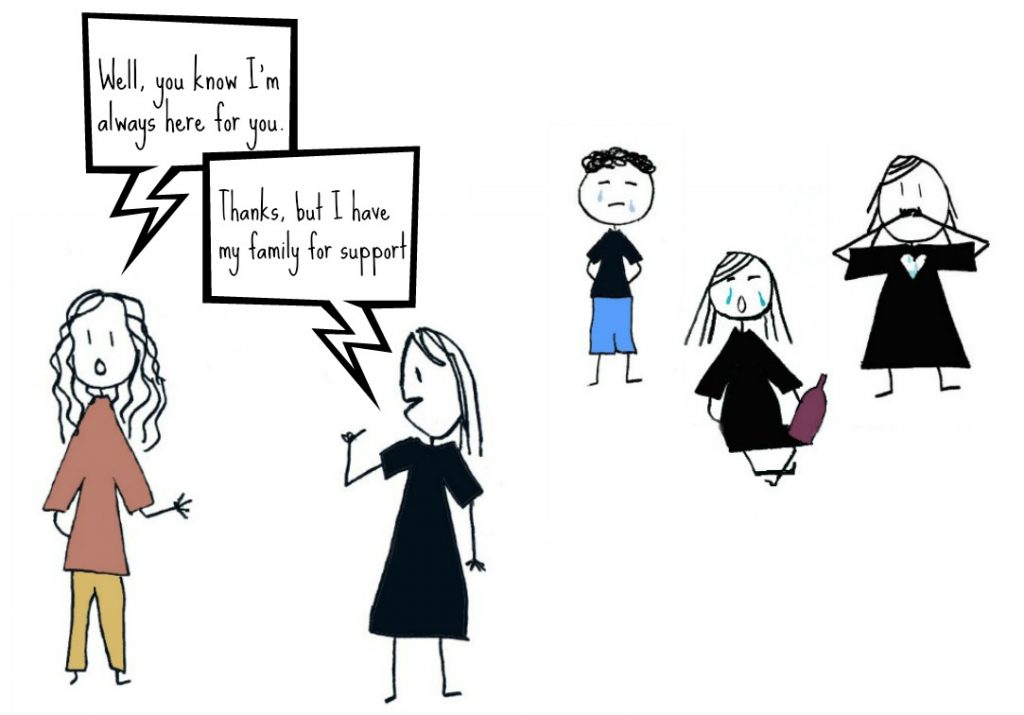
Changing Family Dynamics:
Nosotros just love talking nigh theories effectually here, and then permit'due south beginning with 1. Family systems theory was introduced by Dr. Murray Bowen in the 1960s. Very basically, the family unit systems theory says that families are systems of interconnected and interdependent individuals. Inside the family organization, each fellow member has a office to play and members of the system are expected to respond to each other according to their part and human relationship. Maintaining the same design of behaviors inside a system may atomic number 82 to balance within the family system (only as well to dysfunction).
When someone dies, the whole family system is thrown off. Grieving family members find themselves disinterested and/or incapable of behaving in the ways they used to. Not only do people have to cope with grief, just they too must deal with the fact that a vital piece of the family is gone. Some of the roles your loved one used to inhabit volition have to be filled by family members and, equally everyone adjusts, a seismic shift in the way things 'have e'er been' tin occur.
Different emotions:
Grief can make you feel like you are going crazy. Your response to grief will be entirely different than anyone else's and then volition the range of feelings you lot feel in response to the loss. Here is a partial listing of emotions typically associated with grief:
shock, numbness, sadness, despair, loneliness, isolation, difficulty concentrating, forgetfulness, irritability, acrimony, increased or decreased ambition, fatigue or sleeplessness, guilt, regret, depression, anxiety, crying, headaches, weakness, aches, pains, yearning, worry, frustration, detachment, isolation, questioning faith.
Quite frequently, family members will respond differently to the same death. When each person is going through their ain individual emotional experience, it can be difficult to figure out how to connect with and support one another. When someone you dear is of a sudden angry, depressed or anxious, or numb, your firsthand reaction might be to wish they would snap out of it. Conversely, if you are the one feeling these emotions, you might feel more distant and isolated from your family. In a perfect earth, people would take patience and agreement for i another, only sometimes this is easier said than done.
Birth lodge:
Although inquiry on nativity order is oft contested, I recollect we can all agree that position in the family unit has some impact on who we are equally people, how we comport in the family unit, and the expectations nosotros have for other family members. If you lot have a smaller family, it's far more likely that yous will have a prototypical 'oldest', 'heart' or 'youngest'.
It may be that later a death the oldest child feels they take to step in and take care of grieving parents and younger siblings. If it is a parent who died, perhaps the oldest child feels compelled to fill some of their roles. Maybe the youngest child has been babied and then they feel they need a fiddling extra emotional back up. Regardless, some family members may end up feeling unsupported or forced to step into shoes they feel they cannot or do non want to make full.
This whole dynamic becomes a lilliputian more complicated in larger families. Just, when in that location is a large gap in age between the oldest and youngest, I think information technology'due south interesting to consider the idea that the family the oldest child grew upward with is frequently quite different than the family the youngest child grew up with. This might explicate some differences in relationships and in outlook subsequently a death.
Gender/Grieving Style:
To exist perfectly honest, this heading is a bit misleading. It is not a fact that men and women have entirely different and singled-out grieving styles. Rather, prominent grief researchers Kenneth Doka, and Terry Martin believe that there are different grieving styles that are associated with being characteristically "masculine" or "feminine".These grieving styles be on a continuum and gender is merelycontributes to the way you grieve.For an in depth discussion on their theory, head hither.
Briefly, this theory asserts that there are two types of grievers – instrumental and intuitive.
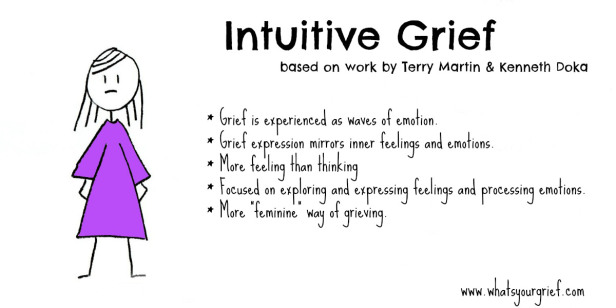
Intuitive grief is experienced mainly in terms of feelings and emotions – "I felt deplorable" or "I felt angry" – and the grief response is usually focused on exploring and expressing these emotions – "I cried all night" or "I got so mad I couldn't remember."
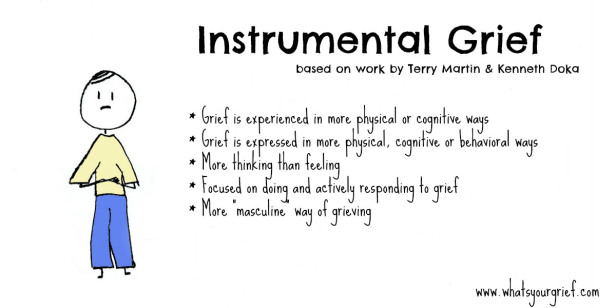
Instrumental grief is experienced in more physical and cerebral ways – "I couldn't end thinking nearly what happened" or "I felt like I couldn't breathe." The instrumental grief response is expressed in concrete, cognitive or behavioral means and looks more similar 'doing' or 'taking action'.
Now, you lot can imagine how misunderstanding would arise when intuitive and instrumental grievers exist in the same family. The instrumental griever, who appears less emotional and more active, might seem cold and uncaring to an intuitive griever who believes that emotions are the expression of grief.
Coping Style:
I'thousand non going to get besides in depth on this topic because we've written about information technology quite a lot. Basically, you lot should never assume that someone volition grieve in the same way as you lot because we all have different coping styles. The WYG philosophy on coping is that each of united states has predispositions toward the rational, the artistic, or the emotional sides of our minds. Though we all certainly accept a bit of each of these within us, we oft lean toward one style over another. To hear more than near this, listen to our beneath podcast on the topic.
Age:
Age and stage of life obviously has a large impact on behavior and how ones makes sense of their globe and experiences. Nosotros've written well-nigh the influence of age on child and boyish understanding; special considerations for grieving teens; and grieving every bit a 20-something. The nigh important have away is the idea that a person's life context has an influence on how they perceive their experiences. Things like admission to support, by experiences, resources, physical health, existential angst all take an touch on grief and also change with age. So in attempting to empathize some other person, it is by and large helpful to accept their stage of life into context.
Secondary Stressors:
Lodge's notion that grief is something that can exist 'dealt with' inside months to a year after a loss seems ridiculous to many. I call up this notion assumes that people have all the fourth dimension, space, and support in the globe to bargain with their hardship. When in reality people have to deal with all sorts of extra stressors like piece of work, school, childcare, etc on top of their grief. Sometimes people take to prioritize and make choices well-nigh the things they will give their fourth dimension and attention to which might hateful…
- Giving less time and attention to the things theyusedto care about
- Having less energy to support other people
- Choosing non to focus on themselves and their grief
- Opting out of time with family and friends
- Becoming overwhelmed
It tin can be easy to lose patience with someone when yous call back they are letting you down or treatment things poorly, but earlier passing judgment y'all should consider all the many things they accept on their plate.
They're in a unlike place:
Although people would take y'all believe there is a timeline associated with grief, there really isn't. So it should near be expected that people grieving the same loss will be at unlike places in their grief at unlike times. You may be ready to talk openly about your loved ones death, while the rest of your family nonetheless prefers to avoid the topic. Your sibling might experience capable of sorting through your loved ane'southward property, while you withal tin't imagine the thought of it. These differences can hands result in misunderstanding and confusion, so advice and patience are key. Although some family unit members may never want to grieve in the same way y'all practise, many times people just need time to find their own peace and perspective.
Abstention and negative coping:
Abstention is 1 of my favorite topics because I think it explains so much of what we practice. We wrote a very comprehensive post on this topic which I encourage you to read. When we talk near avoidance in grief we are usually referring to experiential avoidance.
Experiential avoidance is an attempt to block out, reduce or change unpleasant thoughts, emotions or actual sensations. These are internal experiences that areperceivedto be painful or threatening and might include fears of losing control, beingness embarrassed, or physical harm and thoughts and feelings including shame, guilt, hopelessness, meaninglessness, separation, isolation, etc. At present delight annotation I say "perceive to exist painful or threatening," these perceptions are often subjective and what is perceived as threatening to ane may seem totally irrational to another.
One might avert in grief considering they don't like to experience painful feelings. The onset of a grief wave is sometimes predictable only often not and each new wave brings with it an ocean of unpleasant thoughts, reminders, sensations, and memories.
Many are experiencing emotions of this type and intensity for the first fourth dimension and in response, they may exhibit physical, behavioral and emotional reactions they aren't comfortable with. This may be especially true for those who have withal to develop a reliable fix of coping skills. Although grief is always unpleasant and uncomfortable, for some there are aspects that actually seem threatening and these perceptions tin can atomic number 82 to attempts to control or avoid frightening feelings and reactions.
So, when your hubby is putting away your deceased son'due south property way earlier yous're ready, information technology might exist in an effort to avoid reminders. When your siblings reject to talk with y'all about your deceased father, it might exist in an try to avoid the memories. In grief, avoidance is frequently perceived as a lack of caring when in actuality information technology comes from intense caring.
Avoidance is at the middle of nigh negative coping. Negative coping consists of things similar substance use, staying decorated, and isolation; basically anything you lot can practise to numb, forget, and minimize your exposure to grief triggers. To learn more about negative coping y'all can heed to our podcast on the continuum of negative coping:
Now that you understand the 'why', if your family is fighting in the wake of a death go here for some helpful tips on handling the state of affairs.
Subscribe to What's Your Grief to receive posts straight to your inbox.
Source: https://whatsyourgrief.com/family-misunderstanding/
0 Response to "A Third Answer Maintains and Here Again the Person Has Ceased to Exist at Death"
Post a Comment